

The US smartphone market declined 3% year over year to 33.4 million units in 1Q26, according to Omdia’s latest research. The comparison was against an elevated 1Q25 base when vendors and carriers accelerated inventory build-up ahead of potential US tariff actions. Beyond this comparison effect, US smartphone shipments were pressured by a more restrained carrier upgrade environment, rising memory and storage costs, and delayed device launches that compressed sell-through for key premium models. However, anticipated price increases also drove channel pull-forward for some budget models ahead of 2Q26.
This press release features multimedia. View the full release here: https://www.businesswire.com/news/home/20260527603016/en/
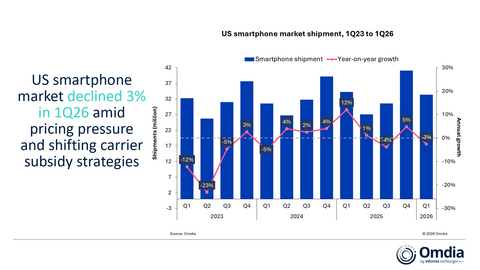
US smartphone market shipment, 1Q23 to 1Q26
“The US smartphone market did not experience a broad demand shock in Q1 2026,” said Eric Chen, Senior Analyst at Omdia. “The decline was modest, but the quarter was shaped by several overlapping factors, including an elevated Q1 2025 comparison, more selective carrier subsidies, rising component costs and later device launches. The result was a market where shipment performance depended heavily on channel execution and timing.”
- Apple maintained its leading position in Q126 despite a 3% year over year decline. Apple benefited from Samsung’s delayed Galaxy S26 launch, limiting direct premium Android competition. The iPhone 17 series accounted for 70% of Apple’s shipments, while aggressive iPhone 15 prepaid promotions continued supporting demand in lower price tiers.
- Samsung ranked second in Q126, with shipments declining 5% year over year as the delayed Galaxy S26 launch. Despite the later timing, the S26 series showed strong early traction, with pre-orders up nearly 25% versus the S25 series. Samsung relied heavily on prepaid-driven A-series demand during Q1, led by the Galaxy A17.
- Motorola was the only major vendor to grow in Q126, with shipments rising 18% year over year. Growth was driven primarily by the refreshed Moto G portfolio, which accounted for more than 70% of Motorola’s quarterly shipments. Carrier and prepaid channels also appeared to pull forward inventory ahead of Motorola’s April price increases.
- Google shipments fell 7% year over year in Q126, as the Pixel 10 series failed to replicate the momentum of the Pixel 9 lineup a year earlier. The earlier launch of the Pixel 10a helped offset some of the decline, while aggressive carrier promotions remained central to Google’s strategy to expand Pixel demand beyond its core premium user base.
“The US smartphone market is becoming increasingly polarized, with premium and entry-tier devices proving far more resilient,” added Chen. “In 1Q26, the $800+ premium segment declined only 1% year over year, supported by Apple and carrier financing. The sub-$300 segment grew by 8%, helped by prepaid demand, plan-linked promotions, and channel pull-forward ahead of price increases on select value models. Meanwhile, pressure was concentrated in the middle of the market, with the $300–599 segment declining 19% and the $600–799 segment falling 6%. This suggests that rising device costs and more selective carrier subsidies put the most pressure on Android mid-range and mid-to-high-end devices, while premium models and budget devices remained better supported by US channel structures.”
“The US smartphone market is entering a phase where carriers are playing a larger role in moderating how rising device costs reach consumers,” added Chen. “While OEM manufacturer’s suggested retail prices (MSRPs) started moving higher in 1Q 26, most consumers have yet to fully feel the impact because carriers continue to manage affordability through financing, promotions and plan-led offers. However, how long carriers can absorb or delay these increases remains a key question for upgrade demand through the rest of 2026.”
These pressures are expected to continue through the rest of 2026, with Omdia forecasting US smartphone shipments to decline 4% year over year for the full year. Beyond near-term pricing and volume pressure, AI-native devices are emerging as a longer-term strategic watchpoint. While such devices are unlikely to drive immediate smartphone substitution, developments from OpenAI and reported interest from Amazon suggest AI-driven interfaces could gradually reshape how consumers perceive smartphone upgrade value.
United States smartphone shipment and annual growth |
|||||
Omdia Smartphone Market Pulse: 1Q26 |
|||||
Vendor |
1Q26 |
1Q26 |
1Q25 |
1Q25 |
Annual |
shipments |
market |
shipments |
market |
growth |
|
(million) |
share |
(million) |
share |
|
|
Apple |
19.9 |
60% |
20.6 |
60% |
-3% |
Samsung |
7.9 |
24% |
8.3 |
24% |
-5% |
Motorola |
3.6 |
11% |
3 |
9% |
18% |
0.8 |
3% |
0.9 |
3% |
-7% |
|
TCL |
0.5 |
2% |
0.7 |
2% |
-17% |
Others |
0.6 |
2% |
0.8 |
2% |
-28% |
Total |
33.4 |
100% |
34.2 |
100% |
-3% |
|
|
||||
Note: “Others” includes Blu, HMD, Kyocera, Nothing, OnePlus and other minor brands. |
|||||
Percentages may not add up to 100% due to rounding. Source: Omdia Smartphone Horizon Service, May 2026 |
|||||
ABOUT OMDIA
Omdia, part of TechTarget, Inc. d/b/a Informa TechTarget (Nasdaq: TTGT), is a technology research and advisory group. Our deep knowledge of tech markets grounded in real conversations with industry leaders and hundreds of thousands of data points, make our market intelligence our clients’ strategic advantage. From R&D to ROI, we identify the greatest opportunities and move the industry forward.
View source version on businesswire.com: https://www.businesswire.com/news/home/20260527603016/en/
© Business Wire, Inc.
Avertissement :
Ce communiqué de presse n’est pas un document produit par l’AFP. L’AFP décline toute responsabilité quant à son contenu. Pour toute question le concernant, veuillez contacter les personnes/entités indiquées dans le corps du communiqué de presse.