


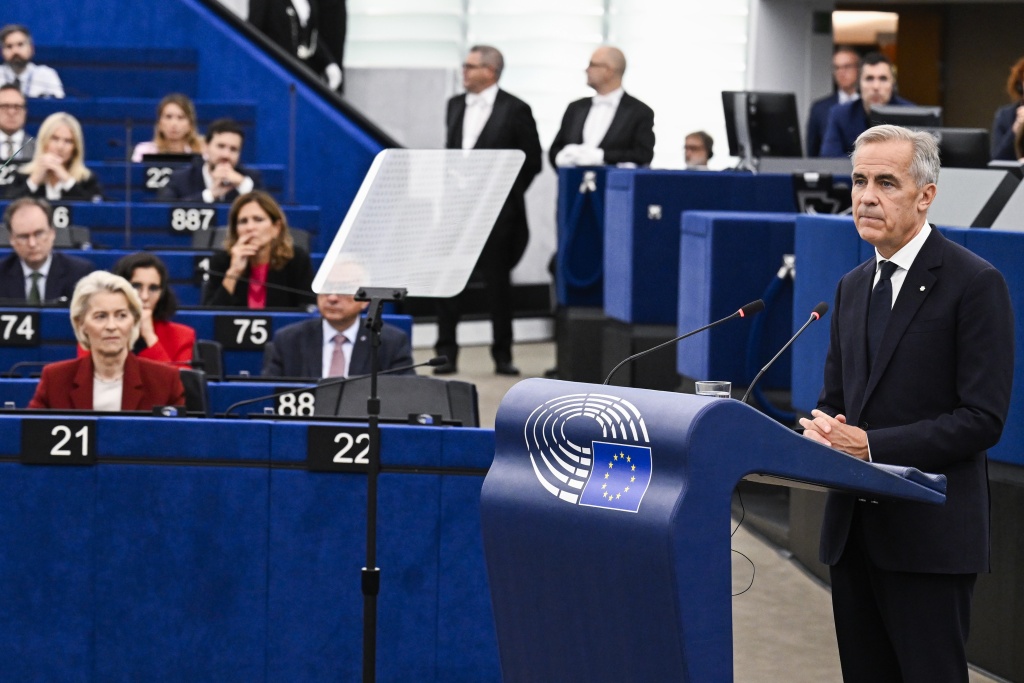
Canadian and European Union leaders meet in Montreal this week for a summit aimed at deepening their alliance as both sides navigate tumultuous relations with the United States.
Prime Minister Mark Carney said "Europe and Canada are stronger together," in an address to the EU Parliament last month, after EU chief Ursula von der Leyen suggested Canada could become the 27-nation bloc's first "associate member."
Leaders at the two-day Montreal meeting will try to hammer out specifics for closer ties in areas including defense, artificial intelligence and critical minerals.
Beyond specifics, the push for new levels of Canada-EU closeness has highlighted the shifting geopolitical realities triggered by US President Donald Trump.
Punished by US tariffs, Canada is seeking new economic opportunities overseas to reduce its dependence on the United States.
Carney says the EU is a logical partner, quipping that his country is "the most European of non-European countries."
For Timothy Snyder, the chair in modern European history at Toronto's Munk School of Global Affairs, Carney's outreach to Europe in response to US hostility is tactically sound.
"If you can be arbitrarily, at any moment, cut off from the American market, then it makes sense to have as much in your back pocket as you can," he told AFP.
"You look for something else, and that something else is Europe," Snyder said, adding that if the US trade war ultimately subsides, Canada will be in a stronger, more diversified position.
The EU, repeatedly ridiculed by Trump and his top domestic allies, is also looking for reliable partnerships in a world dominated by China and the United States.
The bloc has let Canada into its defense procurement alliance and invited Carney and Canadian officials to attend key EU meetings.
The goal must now be to "move from writing each other love letters to real commitments," said Tobias Cremer, a German member of the European Parliament who has backed deeper EU-Canada cooperation.
The contours of the "associate member" status are not fully clear. EU treaties do not outline such a possibility.
A draft joint declaration that could emerge from the summit, seen by AFP, indicates Canada could join the Erasmus student mobility program, the Galileo satellite navigation program or sit on a proposed European security council, a conceptual idea backed by the EU chief.
Trump threatened to cut off EU trade after the bloc proposed associate member status to Canada, calling the idea both "laughable" and "a hostile act."
And Trump isn't the only one to view the notion with scorn.
Angeline Furet, a member of the European Parliament from France's far-right National Rally party, argued the current free trade with Canada is "ruining our agriculture sector."
The Canada-European Union Comprehensive Economic and Trade Agreement, signed in 2016, eliminates import duties on 98 percent of products but has not been fully implemented.
It's hugely unpopular among French livestock farmers and has not been implemented by several members of the bloc, including France.
The idea of closer EU ties has also riled conservatives in Canada, stirring accusations that ordinary Canadians will become subject to onerous European bureaucracy.
"We will never be the 51st state of the US, but we will also never be the 28th state of the European Union," Conservative Party leader Pierre Poilievre said, connecting EU ties with Trump's annexation threats.