


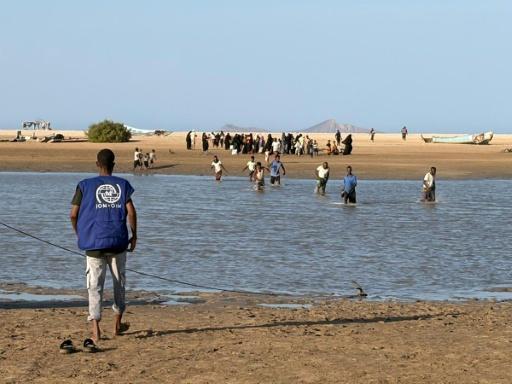
Waheda Muhammad Ali braved a terrifying sea journey from the Middle East to Africa to escape heavy fighting in her native Yemen.
At least 100,000 people have fled Yemen since fighting escalated this month between government forces and Iran-backed Houthi rebels, who have seized control of its coastline.
More than 2,000 Yemenis have travelled to the tiny Horn of Africa nation of Djibouti, its government says, crossing a short but dangerous stretch of water normally used by migrants heading in the opposite direction in search of work in the Gulf.
Some "arrived with goats, refrigerators, or even solar panels, because they think the situation will drag on", Alexandre Coissac, head of mission in Djibouti for the United Nations' International Organisation for Migration (IOM), told AFP.
Ali, 40, fled her home in the Yemeni coastal town of Dhubab.
"Gunfire was everywhere, we were completely helpless, with no food or water," she said. "The children were crying, terrified by the fighting and explosions... We prayed constantly to arrive safely."
The Houthis previously controlled much of northern Yemen, including the capital Sanaa and the western city of Hodeida, but made a lightning advance along the coast this month, seizing the port city of Mocha last Thursday.
They now control the strategic Bab el-Mandeb Strait, a vital passage for maritime traffic between Asia and Europe whose importance has only grown with the blockade of the Strait of Hormuz by Iran in recent months.
Hundreds have been killed in the recent fighting.
"The planes flying over us. Everything was devastated. We had no choice but to flee," said Ali, describing a boat crossing that lasted nearly a full day.
The IOM praised Djibouti's "generosity" in hosting the displaced, who include many young children.
But Djibouti's Minister of Economy Ilyas Moussa Dawaleh said on X that the situation was "increasingly difficult" for his country, which is just 23,000 square kilometres with a population of barely one million.
Qasim Ibn Qasim, a 40-year-old fisherman, fled with his children and extended family on a large dhow.
"We took nothing. We left everything at home. Everything. We just took a few blankets and clothes for the children... Everything else is back there," he said.
"The hardest part is living in constant fear of war," he added.
Djibouti hosts several foreign military bases, including those of the United States and China, and is a key transit point for migrants, mostly Ethiopians, travelling in search of jobs in the Middle East.
Migration flows towards the Gulf have naturally dropped due to the fighting, said Coissac.
But they "will soon return to high volumes, often forcing migrants to take even more perilous routes than before in their bid to reach the Gulf states", he warned.
Latest stories

Business and Economy Stocks edge higher ahead of US Fed rate call
Global stock markets mostly rose as oil prices fell on Wednesday ahead of the Federal Reserve's decision on US interest rates, with policymakers debating how to tame surging...

Society 'Being Heumann' captures joy in fight for disability rights
Sian Heder's new film "Being Heumann" profiles an American activist fighting for the rights of people with disabilities, with the Oscar-winning director saying its message of inclusivity...

Europe Ex-president's lengthy war crimes sentence shocks Kosovo
Kosovo's former president Hashim Thaci was sentenced to 25 years in prison by a tribunal in The Hague on Wednesday for war crimes, in a verdict that sparked...