

Last week, World announced the next generation of World ID, its proof of human protocol, designed to increase trust on the internet. The announcement was made during “Lift Off,” a live event in San Francisco.
This press release features multimedia. View the full release here: https://www.businesswire.com/news/home/20260417530721/en/
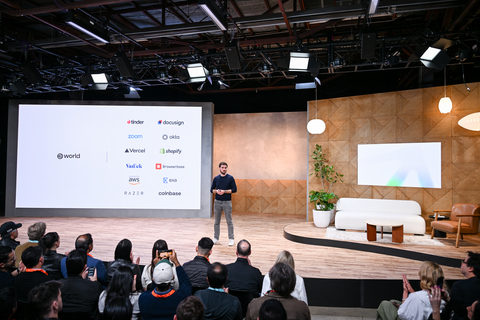
Docusign, Okta, Tinder, Vercel, and Zoom bring World ID proof of human to businesses, AI agents, and consumers
As AI makes it easier than ever to generate convincing content, identities, and interactions, trust online has decreased. World ID addresses this challenge by enabling individuals to privately prove they are a real, unique human, without revealing their identity across apps, platforms, and services.
“If anything online can be faked, you no longer know who or what to trust,” said Tiago Sada, Chief Product Officer at Tools for Humanity, a company building tools for World. “World ID, which has already been used more than 450 million times, is designed to solve that at the root with a simple, privacy-preserving way to prove there’s a real human behind every interaction.”
A Full-Stack Upgrade for Proof of Human
The new World ID introduces an account-based architecture that makes proof of human more secure, more flexible, and ready for widespread adoption across consumer and enterprise use cases.
Key capabilities include:
- Account-based design: Enabling persistent, portable proof of human across apps and services;
- Key rotation and recovery: Improving security and usability for real-world use;
- Multi-key and session support: Allowing seamless authentication across devices and environments;
- Enhanced privacy protections: Strengthening anonymity through one-time-use nullifiers; and
- Open ecosystem: Opening integration to any developer through a new open-source SDK.
World ID for Business: Verifying Humans in High-Stakes Workflows
World ID is expanding to enterprise environments, where verifying that the correct human is taking an action is increasingly critical.
In communication and collaboration tools, identity assurance is becoming essential as deepfakes improve.
Zoom: Zoom is the first communications platform to offer integration of Deep Face directly into its meetings product. The integration delivers a hardware-backed root of trust through a three-way match: the cryptographically signed image taken when the participant originally verified at an Orb, a real-time Face Auth liveness selfie taken on the participant's device, and the live video frame that other participants see on screen. When all three match, the result is confirmation, with high assurance, that the person on the call is the real, verified human who is expected. The integration analyzes video only, not audio.
In digital agreements, the need to tie actions back to a real person is equally important.
Docusign: Docusign and World are teaming up to bring proof of human into the document signing trust model. Through World ID, signers can confirm specific attributes about themselves, proving they are human and not a bot. This establishes a foundation for human continuity in agreement workflows – giving actions, whether performed directly or delegated, ties back to a verified human.
These use cases address growing risks around impersonation, fraud, and AI-generated deception in business-critical interactions.
World ID for Agents: Human Verification in an Automated World
As AI agents increasingly act on behalf of individuals, verifying the human behind those agents becomes essential.
World is introducing new capabilities to ensure a human remains involved at critical moments in automated workflows, including "human in the loop."
World is teaming up with Vercel to bring human in the loop to developers building on Vercel's new open-source Workflow SDK. Developers can add a step to any workflow or agent to require human verification, and every verification is viewable inside each workflow execution for full auditability. The result is a provable record that a human was in the loop when it mattered most. This feature is live today, and it can be installed from npm.
World is also working with Okta to define how humans and agents interact.
Okta is planning to build a new product: Human Principal. Human Principal will allow API builders to verify whether a human stands behind an agent and its actions, and enforce policies accordingly. Humans will be able to verify themselves using a number of verification methods, and obtain device-bound cryptographic proof that carries across products without requiring cumbersome re-verification. World ID, slated to become one of the first Human Principal integration partners, is set to provide Human Principal with a privacy-preserving, user-friendly, and ubiquitous proof of human verification method.*
Once combined, World ID and Human Principal will enable features like rate limits per human for agent traffic, abuse-protected free tiers, and a cleaner onboarding flow for agents that need to access services on behalf of their human principal. The waitlist to join the upcoming Human Principal beta is now open at humanprincipal.ai.
These tools create a verifiable link between human intent and automated execution in the emerging agentic web.
World ID for People: Bringing Trust to Everyday Platforms
World ID is also expanding across the platforms people use every day, especially where authenticity and fairness matter most. One example is online dating, where trust is fundamental to how people connect.
Last year, World and Match Group launched a World ID pilot with Tinder in Japan, providing individuals with a privacy-preserving way to help confirm there is a real human behind the profile. Today, that integration expands on Tinder in select markets, including Japan and the United States, bringing proof of human to Tinder at scale. The experience is simple: verify with an Orb once, connect your Tinder account, stand out with a verified human badge and increase higher-quality connections by showing you’re real, and for a limited time, receive five free Boosts on Tinder, a paid in-app feature that makes your profile one of the top profiles in your local area. That kind of confidence changes how people show up, and when people show up authentically, better connections follow.
Live events are one of the most visible places where dreaded bots cost real fans real money. World also introduced Concert Kit, a new product that allows artists to reserve tickets for verified humans. Artists are already committing to piloting Concert Kit. Thirty Seconds to Mars will reserve a portion of tickets for verified humans on their upcoming 2027 tour, with more details to come. Some reports suggested that Tools for Humanity has a partnership or commercial relationship with Bruno Mars, ‘The Romantic Tour,’ or Live Nation. This is not the case. There is no business relationship, agreement, or collaboration of any kind between Tools for Humanity, World or its related products and these parties.
About World
World is intended to be the world’s largest, most inclusive network of real humans. The project was originally conceived by Sam Altman, Max Novendstern, and Alex Blania and aims to provide proof of human, finance and connection for every human in the age of AI. Find out more about World at world.org and on X.
*Any mention of future products, features, functionalities, or certifications in this press release is for informational purposes only. These items are not commitments to deliver and should not be relied upon to make purchasing decisions.
View source version on businesswire.com: https://www.businesswire.com/news/home/20260417530721/en/
© Business Wire, Inc.
Disclaimer :
This press release is not a document produced by AFP. AFP shall not bear responsibility for its content. In case you have any questions about this press release, please refer to the contact person/entity mentioned in the text of the press release.