


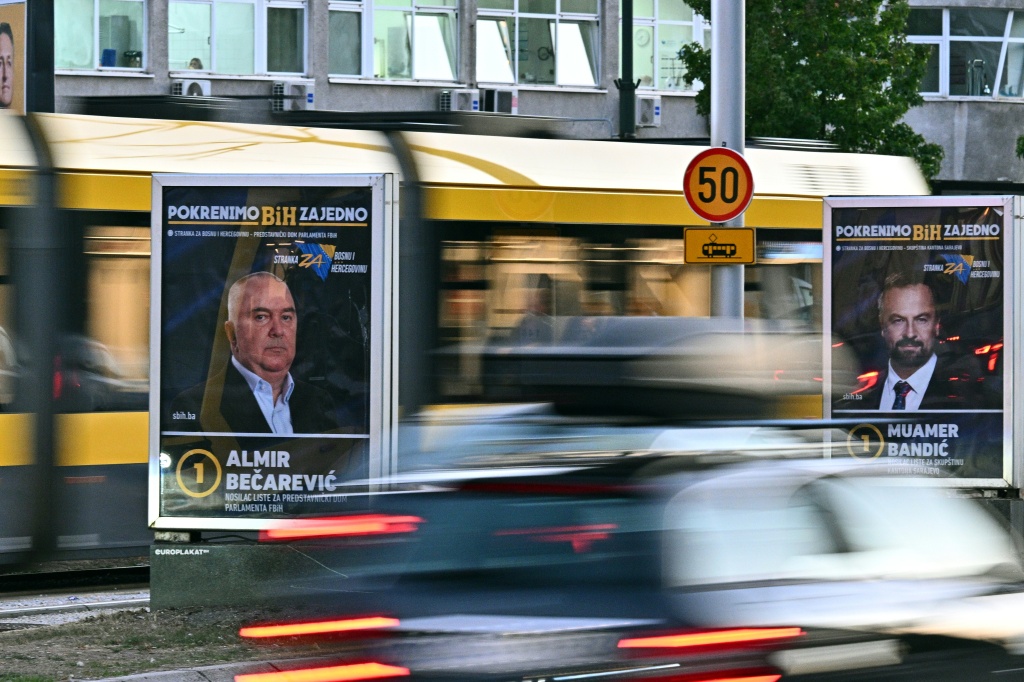
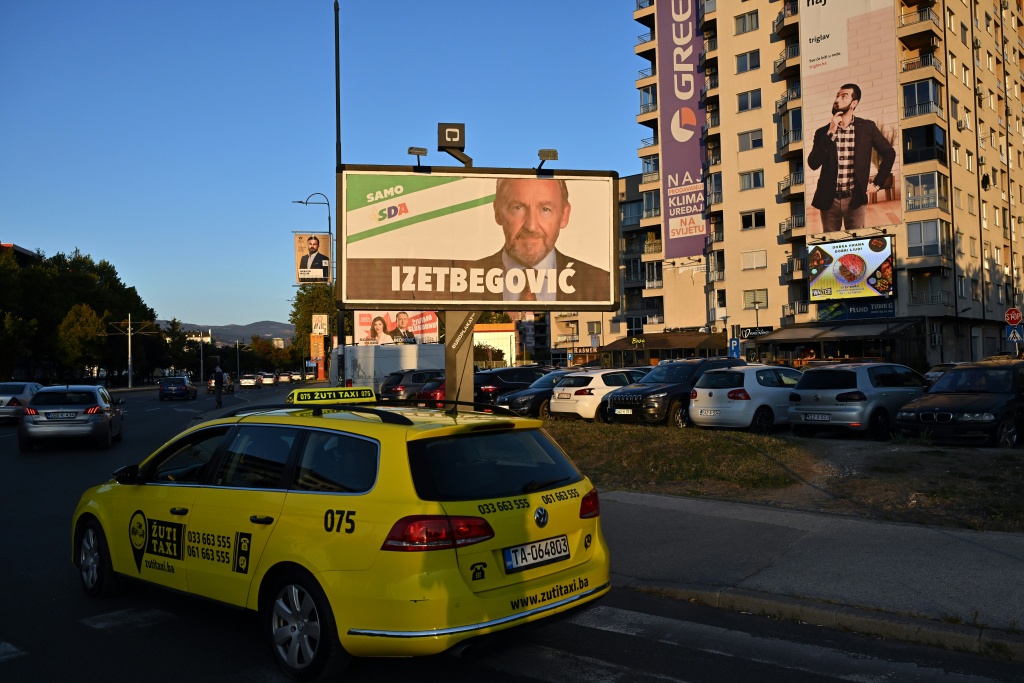
Votes were being tallied in Bosnia's general elections on Sunday as polls officially closed, in a campaign marked by starkly different visions for the divided nation's future.
The results will decide a dizzying number of posts across multiple tiers of government, in a complex system that has held the partitioned Balkan country together since the 1995 peace deal.
Its key race will be for the tripartite presidency, split between Bosnian Muslims or Bosniaks, and the Serb and Croat ethnic groups, with the frontrunners pitting visions of a united country against greater autonomy for its ethnic groups.
But the major parties' repeated focus on war-era rhetoric of ethnic division has frustrated some voters, who hoped for candidates to address economic concerns in one of Europe's poorest countries.
"The situation in the country is not ideal, we could move forward in every sense of the word," said Drazen Gvozdenovic after casting his ballot in Laktasi, northern Bosnia.
The 40-year-old said more needed to be done to address low wages, "so that people can live in peace without needing to worry about meeting their basic needs".
Economist Merima Cerim Karisik, voting in a northern Sarajevo suburb, echoed his view, hoping for change and a turn away from the tired politics of the past.
"That what we have seen over the past 30 years will finally come to an end," she said.
The US-brokered Dayton agreement ended the 1992-1995 conflict but entrenched divisions that have often paralysed decision-making.
It divided Bosnia into two semi-autonomous entities -- the Serb-run Republika Srpska (RS) and a Muslim-Croat federation -- linked by a weak central government.
At the centre of RS politics remains its former president, Milorad Dodik, who repeated his long-running criticism of the central authorities, predicting an "extraordinary" result for his party.
"If we don't go and vote, then we are playing into the hands of those crooks in Sarajevo who are trying to fix everything in order to build a unitary Bosnia and destroy Republika Srpska," he said after voting in Laktasi.
The 67-year-old is not on the ballot after being convicted of overstepping his powers and banned from the presidency for six years.
Despite his party's two decades of dominance in RS, researcher Adnan Cerimagic from the European Stability Initiative (ESI) told AFP that it was "not impossible" for opposition candidate Branko Blanusa to beat Dodik-backed Savo Minic in the race for the RS presidency.
The arrival of biometric identification and the scanning of paper ballots at thousands of polling stations could also affect the result, he said.
So far, a few technical issues have caused authorities to extend voting at some polling stations.
Partial turnout figures, about four hours before polls closed, showed an eight percent drop from the same time at the previous election, with nearly 27 percent of voters casting ballots.
In the Muslim-Croat federation, Bosniak parties are pushing for a stronger central state, with incumbent Bosniak presidency member Denis Becirovic pledging a renewed path to the European Union and NATO.
But Cerimagic said little had changed on that front in years.
"The ruling coalition at state level has made practically no positive progress since 2024, either on reforms or on bringing the country closer to the EU and NATO," he said.
Croat nationalist parties are also pushing for electoral reform, demanding a greater say in choosing the Croat member of the presidency in the entity they share with the more numerous Bosniaks.
But Amela Hadzic, after casting her ballot in Sarajevo, said it felt like the country had gone backwards recently.
"I hope people have seen that things cannot go on like this. I doubt there will be any major changes, but hopefully things will at least get better, however little," Hadzic said.
Latest stories
Society Hundreds of schools to shut Monday as student protests rock France
Up to 500 schools across France will be totally or partly closed on Monday because of a wave of student protests that has shaken the...

Sports Colts top Commanders in NFL London game
Indianapolis running back Jonathan Taylor ran for two touchdowns as the Colts defeated the injury-hit Washington Commanders 30-13 on Sunday in the...

Latin America Rio favela residents vote with little hope
Ground down by violence and the struggle to make ends meet, residents of Rio de Janeiro's largest favela voted Sunday, with little faith that the result will change much in...