


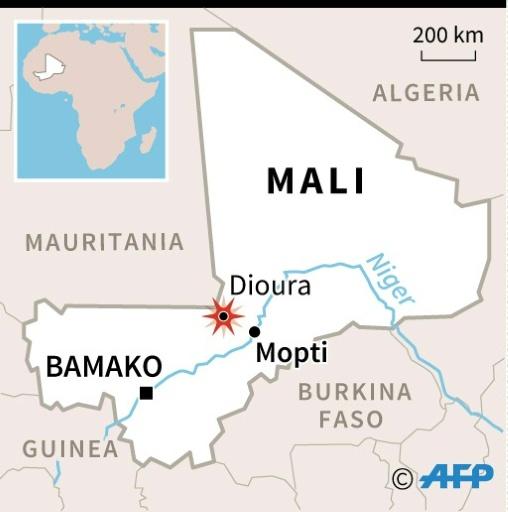
For nearly two weeks Ibou and his family have been living in a state of suspended sorrow, unsure what happened to his father, a soldier stationed at a military stronghold in central Mali that was attacked by jihadists earlier this month.
At least 100 soldiers and five Russian paramilitaries died in the assault on the Dioura camp, claimed by the Al-Qaeda-linked Group for the Support of Islam and Muslims (JNIM), while dozens more were taken prisoner.
With no news of loved ones, the Dioura soldiers' families are living a nightmare, wondering whether their relatives are alive or dead.
"Uncertainty is the worst feeling", said Ibou, whose name was changed to protect his identity given the sensitive conditions on the ground.
"We've called everyone we could to no avail. To this day we know nothing about him," said the 25-year-old student who lives in the capital, an area relatively spared from Mali's larger conflict.
A security source in the region acknowledged to AFP that the tragedy was of "unprecedented scale" for the Malian army, which is entrenched in a conflict that has ravaged the west African nation since 2012.
As usual, the army did not release a casualty count from the attack on Dioura, although it did acknowledge losses -- a rare admission.
Hoping to maintain a sense of patriotism and troop morale, Mali's ruling junta generally remains silent regarding the scale of its casualties in the vast, difficult-to-control country, where jihadists have expanded their grip in recent months.
Malick, whose name was also changed, knows nothing of the fate of his cousin, who was stationed at Dioura.
"We haven't received any messages from headquarters. We have no news at all," he told AFP.
"My cousin is his mother's only child. It's painful. We are very worried", the 44-year-old said, speaking from Kati, the ruling junta's stronghold near the capital.
A few days after the attack, JNIM released several videos on its propaganda channels showing dozens of men it said were soldiers captured at the camp.
According to the group there are 93 in total.
In one of the videos, dozens of men in military uniform are seen sitting in the bush.
One of them speaks to the camera in Bambara: "We are in the hands of JNIM and we are doing well," he says, before calling upon "influencers, the authorities and anyone who can take action" to help them return to their families.
According to the captive, JNIM is demanding the release of its own detained members in exchange.
The jihadists often stage videos featuring their captives, who serve as bargaining chips with authorities.
After unsuccessfully appealing to the army for information, Awa finally discovered her older brother was being held prisoner when she saw him in a JNIM video.
The 25-year-old, whose name has also been changed, lives in Gao in the north and described a feeling "of both relief and anguish".
A few days after the attack, Russian paramilitaries -- which are supporting the Malian junta in its fight -- briefly returned to the site to bury Malian soldiers' bodies and retrieve those of the Russians, a local official source told AFP.
"Some Malian soldiers were buried in mass graves. The Russians recovered their own dead and after they left, witnesses saw burned bodies" at the camp, the source said.
Omar, whose name was also changed, said his 23-year-old nephew had been due to leave Dioura in just a few days but instead was killed.
"Why didn't reinforcements go to save them?" Omar asked.
He said those at the camp were "abandoned -- they were sacrificed".
In mid-July, at least 50 other soldiers lost their lives in northern Mali when a coalition of Tuareg separatists and jihadists ambushed an army convoy.
In recent months, the conflict in Mali has intensified following a major offensive by JNIM and Tuareg allies from the Azawad Liberation Front (FLA), which together killed the defence minister and seized the strategic northern town of Kidal in April.
One Malian father who spoke to AFP said that he spotted his son alive in the JNIM videos after the army told him the young man had died.
The military "now needs to negotiate to save him", the 50-something said.
"We need to make peace now. The war has gone on too long and there are no winners", he said.
Latest stories

Arts and Entertainment Battered Duerer masterpiece up for five-year revamp
Albrecht Duerer's "Feast of the Rosary", a Renaissance gem of Prague's National Gallery, is facing a painstaking five-year reconstruction designed to set right five...
Europe Black Sea drone attacks spell terror for Turkish sailors
They'd just had breakfast when a huge blast brought the crew of the Turkish fishing boat racing out onto main deck, where they were standing...

Digital World Meta leans into AI, smart glasses amid privacy pushback
Meta has spent billions to stay competitive with artificial intelligence, but the tech giant faces growing pushback as CEO Mark Zuckerberg prepares to announce new products built...