


Thailand are the latest country to condemn the organisation at the Aichi-Nagoya Asian Games in Japan, likening it to a "chaotic" game of "musical chairs".
Some athletes have complained of cramped accommodation, delays at airports and hours-long waits to board a cruise ship acting as a floating hotel.
Erratic transport services have seen competitors' buses to training and venues turning up late or, in some cases, not at all.
The continent's biggest sporting showpiece, with more than 17,000 athletes and officials, has faced several issues during its first full week.
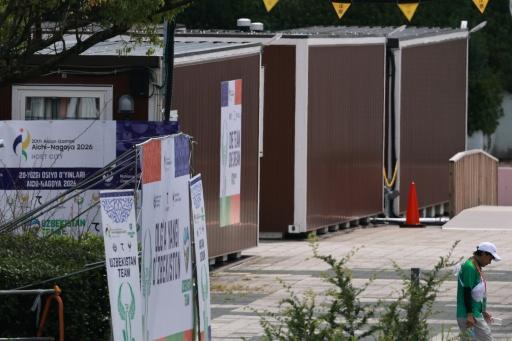
No traditional athletes' village has been built, as a cost-cutting measure, with participants instead staying in temporary container-style huts, hotels and the Costa Serena cruise ship moored in Nagoya port.
Several teams said there was a shortage of rooms.
"It remains a problem from the beginning until now," Chalitrat Chandrubeksa, deputy secretary general of the National Olympic Committee of Thailand, told AFP.
"The number of (rooms available on) cruise ships and hotels does not match our actual number of athletes," he added.
"On the peak day, we required 201 beds on the cruise ship but they provided only 170.
"When athletes checked in and found their names missing from the list, they had to be placed somewhere else and when the new athletes arrived, the previous ones had to move out and look for other hotels.
"It's like musical chairs."
Frustrated athletes have made their feelings known online, with complaints also about some of the food.
More than 4,000 people are staying on the ship in Nagoya's port and 2,000 in the cramped wooden container huts, called "villas" by organisers.
"We are solving the problem by finding replacement accommodations ourselves," said Chalitrat.
"We had to book our own and make advanced payments for food out of our pockets."
The shortages have meant the Thailand team having to put some staff far away from the Games epicentre in the city of Nagoya.
"Our medical team has to stay about one hour 30 minutes from Nagoya.
"We had to rent additional vehicles from Tokyo so they could travel to look after the athletes.
"It has been chaotic.
"We just hope to fulfil and complete this mission as successfully as possible."
Games organisers said Thursday they were working constantly to improve services for athletes.
"We have already increased shuttle buses as much as possible to satisfy athletes' needs," Asian Games organising committee spokesman Hiroshi Koshizuka told AFP.
He admitted issues with transport had occurred but said "there had been no significant impact on the Games and no event has been delayed".
"We have set up a system to respond to complaints and we will address them in a sincere manner going forward."
But still the complaints keep coming.
Steven Chen, spokesman for the Chinese Taipei Olympic Committee, the name for the Taiwan team, said previous experience prepared them for the worst.
They booked 100 extra rooms at hotels in case there was a shortage of beds.
"We were informed at the last minute before departure that there weren't enough beds. That was a major blow to every country," he said.
Chen said that the "biggest headache" was with transport, with schedules frequently changing at the last minute.
"When our team had an evening flight, they suddenly informed us that the afternoon bus to the airport was changed to pick us up in the morning, which caused us a lot of trouble," he said.
dh-pst/