

Published today in Schizophrenia Bulletin, a first-of-its-kind randomized controlled trial (RCT) from researchers at the University of California, San Francisco (UCSF), and funded in part by the National Institute of Mental Health (NIMH), adds to growing literature on the potential benefit of a ketogenic diet for treating psychotic disorders. The study, which enrolled participants with schizophrenia-spectrum or bipolar-1 disorders, demonstrated rapid metabolic improvements with a ketogenic diet compared to diet-as-usual during an initial one-month RCT open-label phase. Furthermore, those who continued with the optional four-month single-arm ketogenic diet extension saw meaningful gains across metabolic, psychiatric, and cognitive measures.
This press release features multimedia. View the full release here: https://www.businesswire.com/news/home/20260618626815/en/
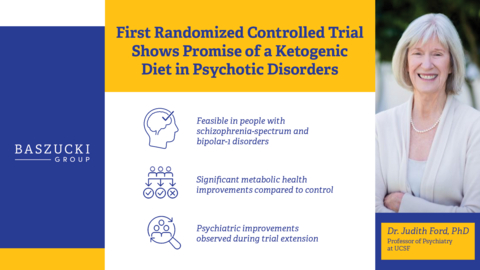
First Randomized Controlled Trial Shows Promise of a Ketogenic Diet in Psychotic Disorders
Of the 58 participants enrolled, 47 completed the initial comparison between a one-month ketogenic diet intervention and a diet-as-usual control group. Twenty-five participants opted to continue the intervention for a total of four months, in a single-arm extension. The study showed high feasibility, with 83% of daily-tested participants maintaining ketosis in the one-month RCT portion and 94% in the four-month extension, with no reports of significant side effects from the diet.
After one month on the ketogenic diet, participants showed statistically significant improvements in key metabolic markers compared with the control group. In this controlled trial, higher ketone levels were associated with reductions in blood glucose and lower depression symptoms (PHQ-9), even after accounting for weight loss, suggesting that ketosis itself, rather than weight reduction alone, may play a role in the observed effects.
The four-month extension demonstrated that metabolic improvements were sustained alongside significant reductions in depression and schizophrenia symptoms, as well as enhanced cognitive performance. While this was a 25-participant single-arm extension, it represents an encouraging signal that the ketogenic diet is a potential intervention for serious mental illness.
“The improvement we saw in cognitive and psychological symptoms is particularly important in people with psychotic disorders, because current medications that address their psychosis don’t address their overall mental wellbeing, including cognitive or depressive symptoms, which can be debilitating,” said study lead Judith M. Ford, PhD, Professor of Psychiatry at UCSF and the Weill Institute for Neurosciences. Dr. Ford noted that while the findings are encouraging, they underscore the need for larger, longer, fully controlled trials to establish whether these benefits hold up at scale.
The authors emphasize that a one-month intervention appears insufficient to capture the potential therapeutic mental health benefits of the intervention, and that the significant cognitive and psychiatric improvements seen at four months need to be replicated under controlled conditions. These results align with recent pilot studies in schizophrenia and bipolar disorder, and together indicate the need for larger, extended randomized controlled trials to test the efficacy and safety of ketogenic therapy in patients with serious mental illness.
“This study reinforces the evidence that ketogenic therapy is a feasible, safe, and potentially transformative treatment for serious mental illness,” said Jan Ellison Baszucki, co-founder and president of Baszucki Group, who was among the funders of the study. “Now is the time for diverse and sustained investment in rigorous scientific examination of metabolic approaches to psychiatry to expand the scope of these studies and to raise awareness for its potential.”
About Baszucki Group
Launched in 2021 by Roblox founder and Chief Executive Officer David Baszucki and best-selling author Jan Ellison Baszucki, Baszucki Group leverages grantmaking, impact investing, advocacy, storytelling, and community building to drive foundational change in science, medicine, farming, food, and environmental ecosystems. A primary focus of Baszucki Group is supporting initiatives at the intersection of metabolism, psychiatry, and neuroscience with the goal of improving mental health outcomes. To learn more about metabolic approaches to mental disorders and brain health, including ketogenic therapy, visit Metabolic Mind, a nonprofit initiative of Baszucki Group.
View source version on businesswire.com: https://www.businesswire.com/news/home/20260618626815/en/
© Business Wire, Inc.
Haftungsausschluss :
Diese Pressemitteilung ist kein von AFP erstelltes Dokument. AFP übernimmt keine Verantwortung für ihren Inhalt. Bei Fragen wenden Sie sich bitte an die im Text der Pressemitteilung genannten Kontaktpersonen/Stellen.