


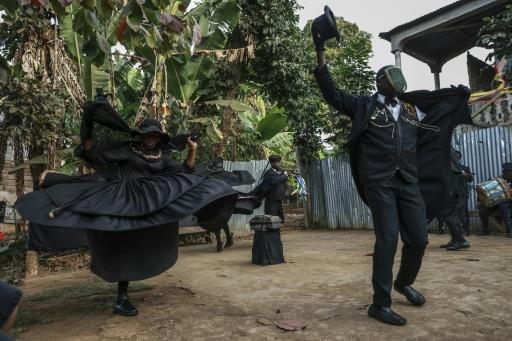
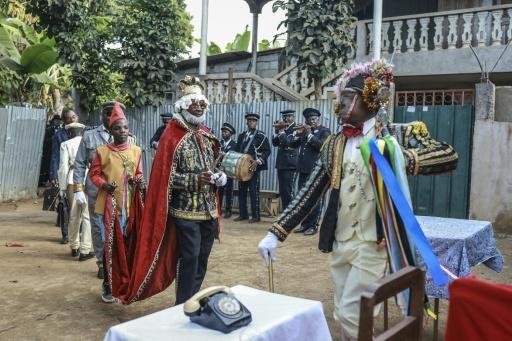
A carved bamboo flute trills before the percussion picks up the pace as the performers on Sao Tome bring a medieval European tragedy to life on the island off Africa's west coast.
Brought to the Gulf of Guinea archipelago nation more than 500 years ago by Portuguese colonialists, the UNESCO-listed tradition of open-air Tchiloli theatre continues to conquer the Sao Tome and Principe public to this day.
"People love this culture because it speaks to something very real: justice," said Marco Carvalho, who plays the traditional Pitu flute for the Formiguinha da Boa Morte troupe, among the most venerable Tchiloli acts around.
"Justice makes no distinction between the rich and the poor," said Carvalho, who at 61 years old has spent more than three of his decades alive in Tchiloli theatre.
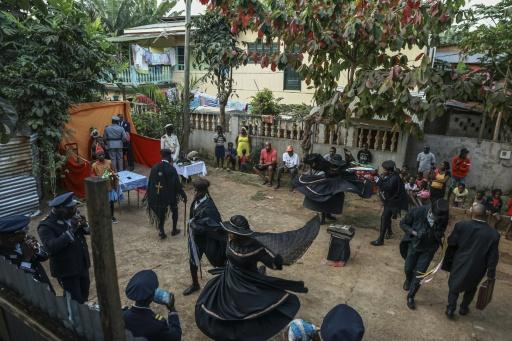
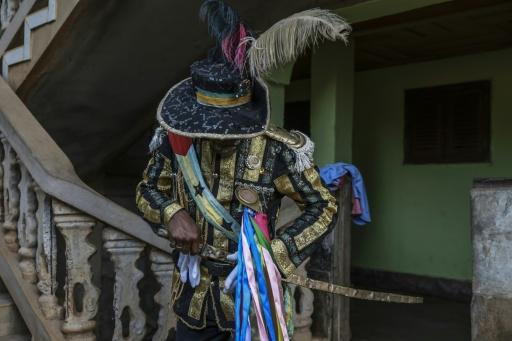
Sporting a flamboyant array of outfits accessorised with beards, wigs and top hats, the troupe spend several hours dancing to the orchestra's rhythm in a courtyard surrounded by homes, to the delight of the spectators.
But the play's script is in Old Portuguese; its inspiration comes from the legends tied to the Carolingian dynasty, which ruled over much of western Europe from the eighth to the 10th centuries AD.
At the story's heart lies a crime: the Emperor Charlemagne's heir, Charles the Younger, kills a knight during a hunting meet.
So the knight's uncle, the Marquis of Mantua, demands that the emperor bring his own son to trial, which sees Charles the Younger convicted in public.
"It spreads a very important message," said 19-year-old spectator Maribel Borja. "Everything must be just. Who sows evil reaps evil."
For the central African archipelago nation's culture ministry, Tchiloli theatre is a "unifying art" that must be protected.
"It reaffirms the primacy of law, the rule of law, the virtues of dialogue, and promotes living together and peaceful coexistence," the ministry said.
Since the Portuguese brought Tchiloli's ancestor to the islands as early as the 16th century, the tradition "maintained itself in the archipelago across many years by taking the form it has today and by integrating (the archipelago's) cultural values", it added.
Carvalho, the veteran Pitu flute player, agreed that "Tchiloli in itself did not originate from the island".
"It is an art adapted from European culture," he said.
His 35-year-old colleague, Jardel Moniz Fernandes, has spent a year fulfilling his childhood dream by taking on the character of Ganelon in the Formiguinha da Boa Morte troupe.
In the tales, Ganelon betrays Charlemagne to the Saracens at the Battle of Roncevaux Pass,
"I love it all, really all of it: the dancing, the sound of the flute, the drum," Fernandes said.
"I've two children, and soon enough I will start to prepare my eldest to act," he added.
As with many before him, the centuries-old tradition will then pass down to the generation to come.
Latest stories
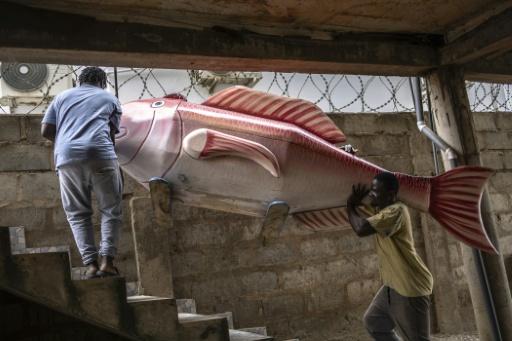
Espanol En Ghana, ataúdes monumentales cuentan la historia personal de los difuntos
El músico ghanés Frederick Teiko Ofori pasó gran parte de su vida con una guitarra entre las manos, y cuando falleció en un accidente de tránsito su familia decidió que el instrumento debía acompañarlo en su viaje final. Por eso, su ataúd...

Espanol Fallece a los 70 años la cantante de jazz estadounidense Cassandra Wilson
La famosa cantante de jazz estadounidense Cassandra Wilson, ganadora del Grammy, murió el miércoles a los 70 años en su ciudad natal de Jackson, en Misisipi, anunció su agente de...

Montevideo Alcaraz sube otro escalón en el US Open y Sabalenka mete miedo
El español Carlos Alcaraz superó el miércoles una segunda prueba más exigente en el Abierto de Estados Unidos, donde la campeona Aryna Sabalenka sacó sin...