


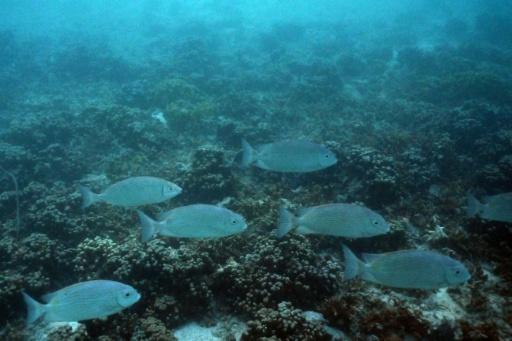
The Pacific islands will face food shortages and drinking water will be impacted by rising seas, scientists said Wednesday, as a UN report found the world would fail to limit global warming to 1.5C.
A UN Environment Programme (UNEP) report projected global temperature rise will peak at 1.8C above pre-industrial levels, overshooting a goal of limiting warming to 1.5C set by the Paris Agreement.
Scientists told a summit of Pacific leaders in Palau that the impact of "overshooting" that target will be a $90 million loss in fishing licence fees, or 13 percent of government revenue in the region, causing an "economic crisis".
Tuna will migrate east, away from island states where a third of the world's tuna is caught, said Andrew Jones, deputy director general of The Pacific Community.
Coastal fishers that feed island people will lose 65 percent of their catch, he told reporters on Wednesday.
"That's about two meals per family per week that is not on the plate -- of clean, free healthy protein that will need to be replaced," he said.
Devastating floods will increase, and salt water will inundate drinking water, reducing the ability to live on islands, he said.
Maina Talia, climate change minister for low-lying Tuvalu, said the science showed the climate crisis "is real now, it is here now".
Pacific islands are seeking financial help for climate change adaptation and tougher action by developed countries to curb the use of fossil fuels.
"We are fighting against a very strong current that is sweeping us into very dangerous waters and we have to do everything in our powers to fight our way back to 1.5," said Marshall Islands climate envoy Tina Stege.
Vanuatu's climate change minister Ralph Regenvanu urged countries such as Australia, the largest member of the Pacific regional bloc and a major exporter of coal and gas, to stop expanding its fossil fuel exports.
"Australia is not doing enough. Australia is a major producer of fossil fuels, we all know fossil fuels are the primary driver of the crisis," he told reporters.
Australia's Prime Minister Anthony Albanese said his country's energy transition "can't happen overnight", adding gas had a role to play in the transition to renewables.
"We all need to do more," he said.
Latest stories

Weltgeschehen Rücksichtslos gefahren: Golf-Star Tiger Woods verliert vorerst Führerschein
Nach einem schweren Verkehrsunfall im Frühjahr darf sich Golf-Star Tiger Woods vorerst nicht mehr ans Steuer setzen. Ein Bezirksgericht in der Stadt Stuart im US-Bundesstaat Florida entzog dem 50-Jährigen am Mittwoch für fünf Jahre den...
Topthemen Ermittlungen nach Angriffen auf Umspannwerke wegen Anschlagsverdachts
Nach den Angriffen auf Umspannwerke in Nordrhein-Westfalen und Brandenburg wird in beiden Fällen wegen des Verdachts von Anschlägen auf die kritische Infrastruktur ermittelt. "Es besteht der Anfangsverdacht einer verfassungsfeindlichen Sabotage", sagte Nordrhein-Westfalens Innenminister Herbert Reul (CDU) am Mittwoch in Düsseldorf vor Journalisten. Die Polizei sprach von einem "Anschlagsgeschehen". In Brandenburg...

Sports Nach Autounfall: Woods bekennt sich doch schuldig
Golfstar Tiger Woods hat sich nach seinem Autounfall im März in Florida der fahrlässigen und rücksichtslosen Fahrweise schuldig bekannt. Der 15-malige Major-Sieger wird seinen Führerschein im Rahmen einer Vereinbarung mit der Staatsanwaltschaft für fünf Jahre verlieren, im Gegenzug wurde der...