


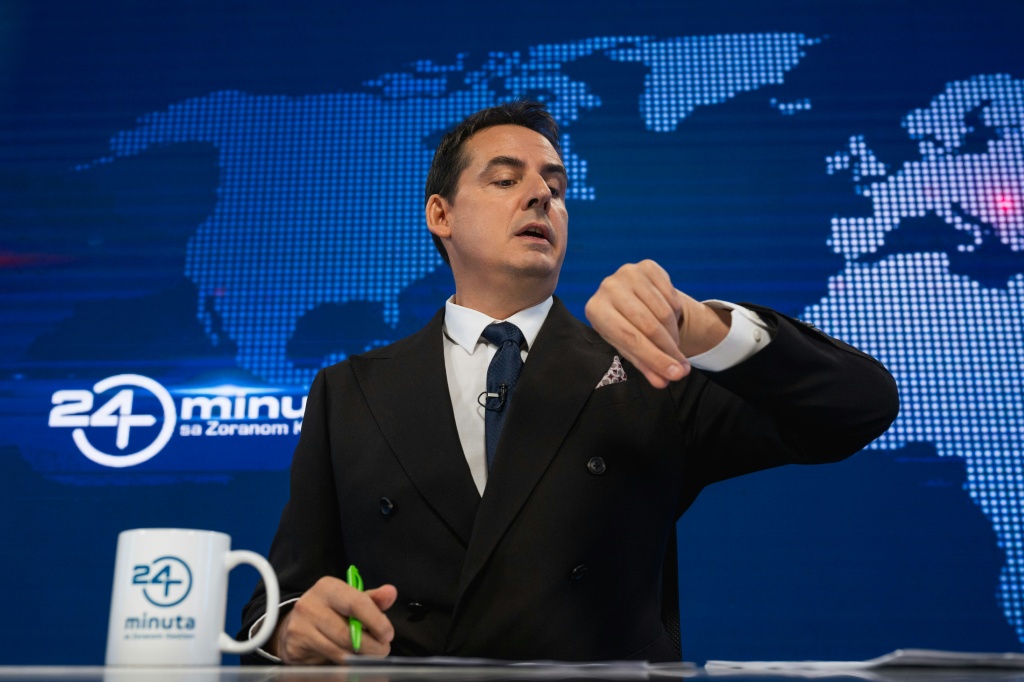

Weeks before Serbia's highly anticipated election, Zoran Kesic, the country's star late-night talk show host, opened his monologue with a stark warning.
"These elections determine whether our children will stay here," the seasoned journalist told his audience, staring down the lens in his usual suit and tie.
The snap poll on October 25 pits the dominant Serbian Progressive Party (SNS) against a student-led movement that has evolved from nearly two years of anti-government protests into a political force.
But ahead of the vote, Kesic lost his television platform when his channel dropped his show, citing "commercial reasons".
"It seems absurd that one of Serbia's most popular and most watched shows has no place on television," Kesic, who now delivers his acerbic political takes directly on YouTube, told AFP.
He is one of the most high-profile examples of what media watchdogs have warned about for years -- independent voices being squeezed out of the mainstream as pro-government coverage proliferates.
"We know the authorities want to silence every critical voice," he said.
Ardent support for former President Aleksandar Vucic -- who remains the central power figure for the SNS and is its candidate for prime minister -- is easy to find on television and in tabloid media.
A recent rally for his populist SNS was carried live by 46 television stations in a country of just 6.6 million people, according to election monitoring group CRTA.
In-depth coverage of student-led gatherings, among the largest since the fall of strongman Slobodan Milosevic in 2000, is largely confined to three broadcasters.
Government loyalists launch vitriolic, often expletive-laden attacks on opponents through outlets such as Informer, which publishes across print, online and broadcast television.
"I think we are entering the last phase of media capture in Serbia," said Pavol Szalai from Reporters Without Borders (RSF).
The media watchdog ranked Serbia 104 out of 180 countries in its May press freedom index -- last among 40 countries in the EU-Balkans zone -- citing political pressure, threats and lawsuits.
Kesic's former employer, Nova, has now come under new management -- its parent, Adria News Network, which operates major independent media outlets across the region, was bought by Portuguese investment group Alpac Capital.
The buyout sparked fears in newsrooms that new management could threaten editorial independence, including at N1, one of the most watched broadcasters critical of the government.
Management says the outlets will maintain professional standards but journalists from Nova, N1 and other Adria-owned portals have protested "for the survival of the media".
"Overhauling newsroom leadership weeks before elections is not in line with European standards," Szalai said, warning that it could deprive voters of independent reporting.
Szalai warned that Serbia is also the only country in RSF's EU-Balkans region where journalists have been forced into exile over their work.
Aleksandar Radic, a defence journalist, fled Serbia in June after reporting on the alleged use of a sonic weapon against protesters during a March 2025 rally in Belgrade.
The demonstration -- one of Serbia's largest in decades -- descended into panic after a mysterious noise sent crowds fleeing, fuelling claims that police had used a "sound cannon" -- an allegation authorities deny.
Radic's analysis focused on a device photographed on a police vehicle at the rally, which he said resembled a US-made LRAD acoustic device.
His analysis was widely picked up across Serbia and international media.
"From that moment on, I felt growing hostility from the system," the independent reporter told AFP from an undisclosed location abroad.
Police interrogated him, raided his home and office before accusing him of plotting against the constitutional order.
Radic said he fled, fearing he would be jailed for his journalism and could return to Serbia safely only if "the government changes".
After the decision not to renew Kesic's show, hundreds protested in Belgrade, in a sign of his popularity.
"I can see that from the number of views on YouTube and the public's reaction to our show," he added, pointing to the channel's more than 700,000 subscribers.
"Sometimes even government voters laughed at our observations," he said.
RSF's Szalai said it was clear why Kesic had been targeted.
"Dictators hate humour," he said.
Nova's news portal has responded to threats of journalist boycotts by offering the newsroom a choice: work under the new editors or accept a severance package.
For Kesic, switching to direct audience support was easier because of his decades-long profile but he worries about other journalists who may face pressure.
"Where will they go?" he said.