


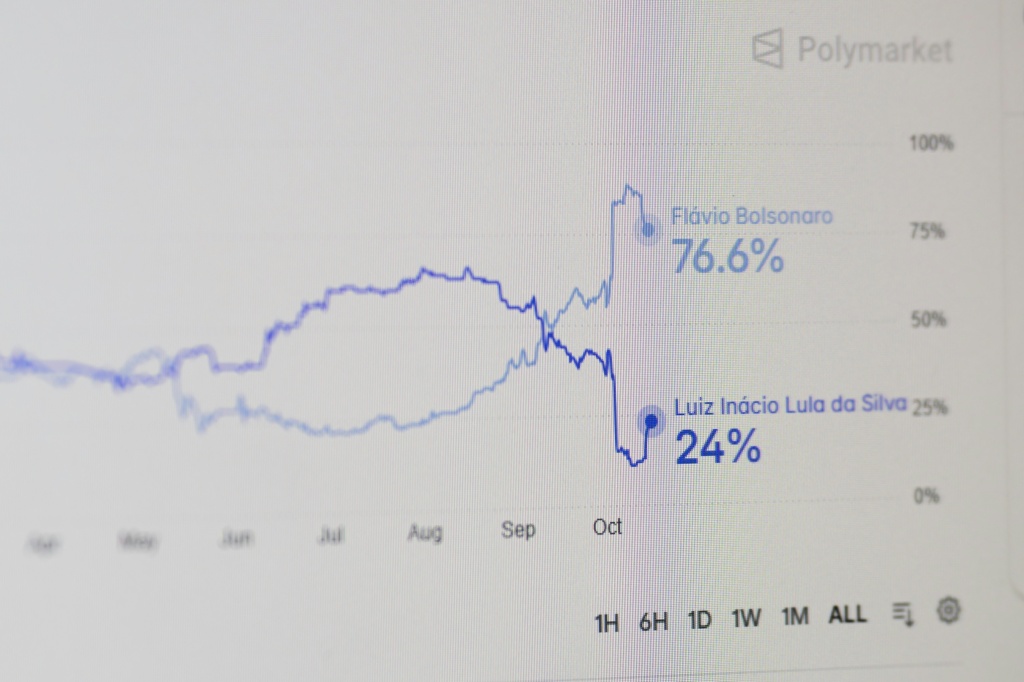
Polymarket, the world's largest prediction market, may be banned in Brazil, but right-wing figures have embraced its election odds as an accurate litmus test of voter intent, amid distrust of opinion polls.
Polymarket allows users to buy and sell shares tied to the probability of real-world events, from who will win the Oscars to the outcome of an election or potential ceasefire between Ukraine and Russia.
The hottest bet in Brazil in recent weeks has been the outcome of the election, which goes to a second round on October 25 and pits right-wing Senator Flavio Bolsonaro against incumbent Luiz Inacio Lula da Silva.
"We are going to get rid of Lula forever," right-wing influencer Paulo Figueiredo said on X before the first round, sharing a Polymarket chart giving the son of former president Jair Bolsonaro a 63 percent overall probability of winning the presidency.
Before the first round, opinion polls showed Lula ahead in the first-round race.
Instead, he finished around two points behind his rival, renewing debate over whether pollsters are underestimating Brazil's right.
Recent polls have Flavio Bolsonaro in front of Lula ahead of the runoff by about two points, which is within the margin of error.
Bolsonaro's odds of winning currently stand at 77 percent on Polymarket.
On social media, posts featuring charts and captions like "Flavio Bolsonaro has skyrocketed on Polymarket" or "Lula has lost" have gone viral in recent days.
Polymarket told AFP that bets placed on events via the platform constitute "neither polls nor official projections, nor expressions of support for any candidacy."
As multiple social media users claim Polymarket is the "best poll," experts warn it is misleading to use a prediction market as a barometer of electoral support.
Unlike opinion polls, which measure voting intentions at the moment voters are questioned, prediction platforms merely record financial transactions, political scientist Carolina Botelho told AFP.
Prediction markets also measure expectations, and bettors can repeat the same bet multiple times, while polls attempt a snapshot of the entire population.
The US-based website is banned in dozens of other countries such as France, Germany, and Japan.
Users have traded about $185 million in contracts on the outcome of Brazil's election.
Lula's administration banned Polymarket and other prediction platforms in April, warning they could increase household debt in Brazil, although a VPN (virtual private network) can be used to bypass the ban.
Brazil's finance ministry has said it is monitoring the effectiveness of the ban on Polymarket and may take further measures to reinforce it.