


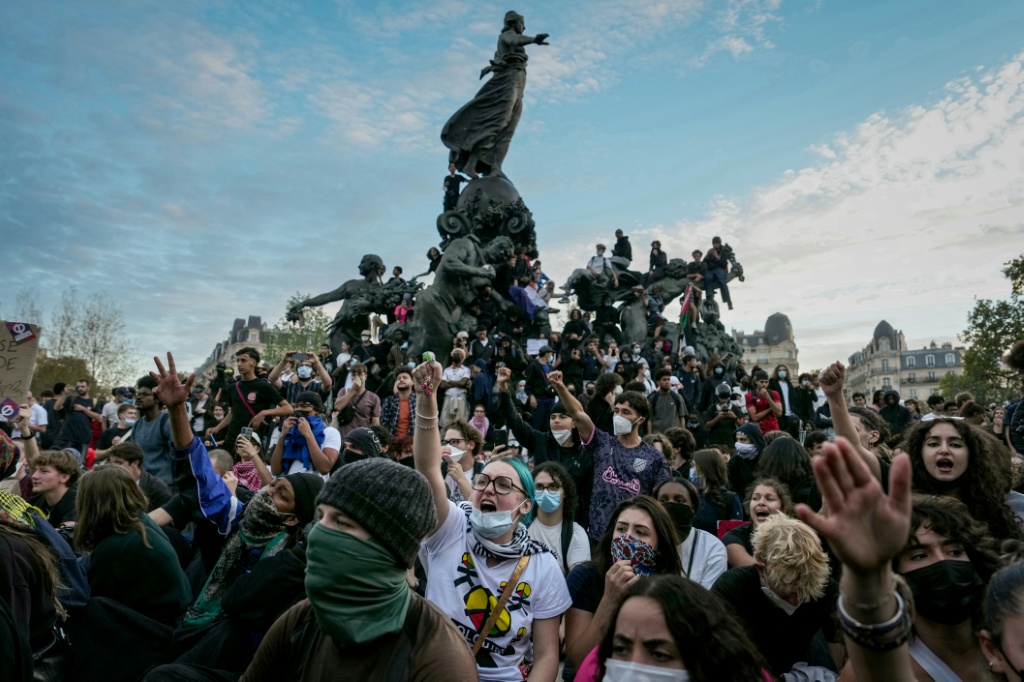
As drums pounded and chants rang out, 16-year-old Yanis, flanked by a knot of friends, rattled off why he had joined tens of thousands surging through the streets of Paris on Tuesday to demand better learning conditions.
"There are no toilets, no toilet paper, everything is broken," he said, his schoolmates nodding and chiming in.
"We go to class from 8:00 am to 6:00 pm with a one-hour break."
"There are 36 of us in class. We can't study," the teenager from the northern Paris suburb of Sarcelles told AFP, calling conditions at his high school "unacceptable".
He was among some 56,000 people who poured onto the streets of Paris on Tuesday as part of a protest movement that began in late September.
Across France, students and teachers have blocked the entrances to hundreds of high schools for 15- to 17-year-olds, protesting against teacher shortages, overloaded timetables, ill-equipped classrooms and buildings not designed to cope with rising temperatures.
On Tuesday, protesters flooded into the Place de la Republique in central Paris, hoisting signs.
"2026 is the new 1789," declared one, a nod to the French Revolution.
Another placard took the form of an oversized middle finger.
The scent of merguez sausages -- a fixture of French demonstrations -- drifted through the square.
Demonstrators danced and clapped to pounding drums, breaking into chants calling for President Emmanuel Macron to resign and denouncing the far right ahead of presidential elections next year.
But beneath the festive atmosphere, some of the young protesters struck a bleaker note.
Fidele, 15, who had come with Yanis, dreamt of becoming a lawyer but said conditions at his school had left him pessimistic about whether he could get there.
"When I see the system, I tell myself that I don't have a future" in this country, he said.
Nearby, 16-year-old Noham had his sights set on becoming a computer engineer, but worried that overcrowded classrooms and teacher shortages were putting that ambition out of reach.
"Without access to an education, I can't have the job I dream of," he said. "It's an enormous amount of stress."
Nadine Zilliacus, an educator for 20 years, said she had seen the same disillusionment take hold among even younger pupils, who increasingly expressed a "really dark" view of what lies ahead.
"We tell them you have to prepare for the future with a job you like," she said.
"Even in middle school they tell us: 'There's no point, anyway we won't have jobs'."
Further along the route, the crowd pressed towards the march's endpoint, clapping and chanting before voices swelled into a rendition of the Marseillaise, France's national anthem.
From a balcony overhead, a silver-haired woman leaned out to encourage the protesters below.
Spotting her, the crowd turned their faces upwards and broke into chants of "Mamie! Mamie!" -- an affectionate French term for grandmother.
Among those making their way through the crowd was Ami, 17, who had travelled into Paris with a group of friends to protest against conditions at her high school in the city's suburbs.
"Compared with schools in central Paris, we're neglected," she said.
As the march reached the Nation roundabout, the festive mood began to shift, with police carrying riot shields barring the route and some protesters throwing stones at the officers.
As Ami and her friends drew closer, the boom of tear gas canisters fired by police cut through the singing.
The girls screamed and stopped in their tracks, unsure whether to keep moving forward.
Nearby, a middle-aged woman had mascara streaking down her face after being caught in the tear gas, while a young man comforted her.
Ami said she did not understand the police response.
"We're just protesting, we're singing, and that's all," she said, adding that she was scared.
After a day of drums, chants and dancing through the capital, she was ready to leave.
"We just want to go home," she said.