


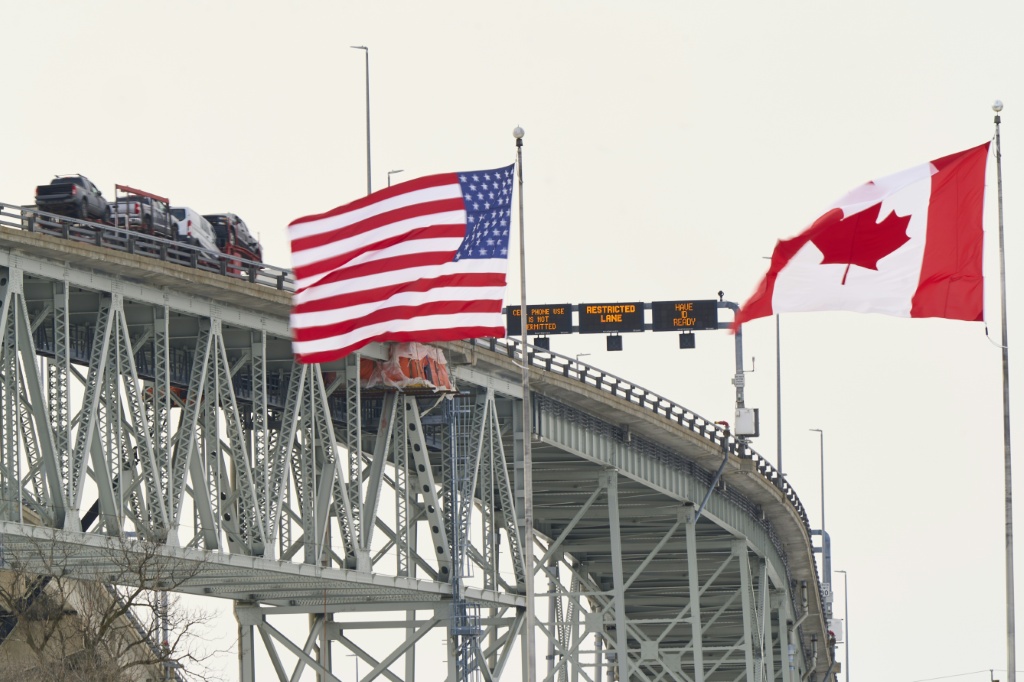

Retired cop Micky Roe sat in his Chevrolet pick-up on the US side of the St. Clair River, watching the Canadian flag flutter on the opposite bank, shaded by the imposing Blue Water Bridge linking the neighboring countries.
Before November's midterm elections, President Donald Trump imposed 50 percent tariffs on a portion of the $880 billion annual US-Canada trade, disproportionately impacting Michigan border towns like Port Huron on the US side of the span.
"It should not be that way, cause we were friends before, real good friends and they should stay that way," said Roe, 83, whose father was Canadian.
As 18-wheelers rumbled over the bridge, Roe speculated that Trump was profiting financially from the tariff campaign against Canada.
Every year, over 1.5 million trucks traverse Blue Water Bridge, accounting for $42.2 billion in road trade, according to Canadian officials, with volumes expected to be down in the wake of the trade war.
Trump, who alleges Canada discriminates against US commerce, has openly derided Canadian Prime Minister Mark Carney for imposing retaliatory tariffs, calling him "nasty" and "ungrateful."
Washington's embassy in Canada even claimed Wednesday that the measures amounted to an effort to influence the midterms.
In the riverfront parking lot facing Canada, another driver who declined to be named said he supported Trump's clampdown.
"They've been taking advantage of us," said the keen Trump supporter from the driver's seat of his truck before accusing the Canadian side of failing to properly fly the US flag at its border control area.
St. Clair County, home to Port Huron, voted for Trump by more than 34 points in 2024.
But local anger at Trump's measures has made the region fertile ground for Democratic candidates seeking to woo disaffected Republicans in November 3 midterm elections widely seen as a referendum on the president.
Abdul El-Sayed, the Democratic candidate for a must-win US Senate seat, managed to draw a crowd of more than 1,000 people at a recent campaign event in Port Huron, a town of just under 30,000 residents.
He told the gathering that living costs were being driven up by "this insane tariff war that we have no business fighting with our neighbors in Canada."
"I mean, look, if you want to tariff the hell out of Ohio, go ahead," he said of Michigan's perennial rival to laughter from the crowd. "But not Canada."
Attendee Patti Lossing, 65, a retired homemaker, said "income and the economy (are) what hit Michigan."
"Between arguing with Canada, our sister country, and the prices that we are paying, Americans are not silly, they're not stupid," she continued.
"They see it every day when they go to the grocery store, when they go to pick up a prescription."
Beyond the war of words between Trump and Canadian leaders, tariffs are hammering Michigan's all-important automotive sector.
"These are very intertwined, interconnected, interdependent supply chains," said Glenn Stevens, chief automotive officer at the Detroit Regional Chamber.
"They're friends first, they're business partners as well. So it's put a lot of strain on these relationships, and it's put a lot of strain on the companies financially because tariffs are an increase in input costs, so the cost of doing business has gone up."
Cars from the US accounted for 28.4 percent of new-vehicle sales in Canada in the first half of the year, down from 35.4 percent a year earlier, according to JD Power Canada, which blamed tariffs for the dip.
Republican US Representative Lisa McClain recently hinted on local radio that Trump might visit the Port Huron area to support El-Sayed's rival, Republican Mike Rogers, although nothing is confirmed.
Rogers, who is seen as close to Trump and won the president's endorsement in the tight senate race, has distanced himself from the president's trade measures.
"We've got to end the Canadian tariff war. It is certainly not helpful to us. It is not helpful to our automobile industry," Rogers said recently.
"But there are tariffs that have helped," he said, subsequently claiming in a FOX News interview that some Michigan manufacturers had added shifts at their factories because of increasing demand for products made in the US.