


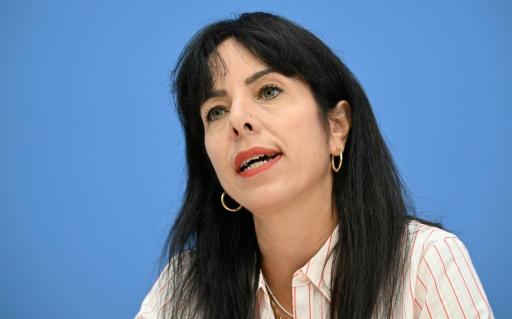
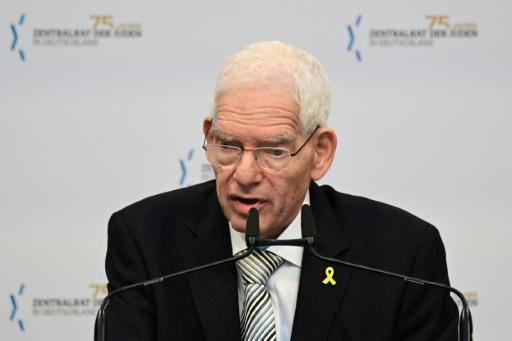
The main Jewish community group in Germany urged the far-left Die Linke to tackle antisemitism in its ranks as the party seeks to take power in Berlin following an election victory, in an interview with AFP.
The party late Friday voted to open talks with the centre-left Social Democrats (SPD) and the Greens on forming a coalition government, aiming to pave the way for their candidate Elif Eralp to become Berlin mayor.
But the efforts are being complicated by mounting allegations of antisemitism among some of its members.
Josef Schuster, president of the Central Council of Jews, acknowledged Eralp had made her opposition to antisemitism -- repeated at Friday's conference -- clear.
"I have heard her statements," he said. "But the problem I see is that her stance is obviously not shared within the party she represents in Berlin, at least not by everyone -- I fear not even by a large majority."
He cited the case of Ferat Kocak, a national lawmaker representing Berlin's Neukoelln, a diverse district home to many people of Middle Eastern heritage where the local party branch is regularly accused of antisemitism.
Kocak has announced he is suspending his parliamentary activities after uproar erupted when he was pictured with Ibrahim Ibrahim, described by German media as a supporter of armed Palestinian militants, at Die Linke's victory party.
He has also acknowledged contacts with a family of Middle Eastern origin that is often linked to organised crime. The group's head, Issa Remmo, also made an appearance at Die Linke's election-night party.
But Schuster said that he would have expected Kocak to be "immediately expelled" from Die Linke's parliamentary group.
"That would have been a clear signal. That is obviously, quite deliberately, not the case," he said.
If a member is expelled from a party's parliamentary group, they do not lose their seat in the legislature but have some rights curtailed, such as speaking time in debates and financial resources.
"What frightens me most is that it seems impossible to get this local Neukoelln branch to renounce clearly antisemitic positions. I have not heard anywhere that it is distancing itself from them," Schuster said.
Without addressing the Kocak case directly, Kerstin Wolter, co-leader of Die Linke in Berlin, said Friday some in the party had "crossed a line".
"It is our duty to get to the bottom of these cases," she said, adding the party stood "for Israel's right to exist and for Palestine's right to exist".
Die Linke has said the election-night party was a public event and that Ibrahim Ibrahim and Issa Remo were asked to leave once they were seen.
The party has taken pro-Palestinian positions as Israel's war in the Gaza strip ground on, but critics say some of its members have veered into antisemitism or hate for Israel.
Accusations of antisemitism remain highly sensitive in Germany due to the country's dark World War II and Nazi past.
Chancellor Friedrich Merz's centre-right CDU party has suggested that Die Linke should be monitored by intelligence services, and Schuster indicated he was open to this idea.
Authorities should consider this step "when extremist views are expressed in parties and in some cases go unchallenged," he said.
Eralp, speaking earlier this week after the party's victory in the weekend vote, pushed back against such charges: "Celebrating violence and terrorism is absolutely unacceptable," she said.
On Thursday some 150 Jewish residents of Berlin, many of them artists and intellectuals, published a letter in left-wing daily Taz rejecting the idea that Die Linke poses a danger to Jews.
Among the party's critics, however, have been members of the SPD and Greens, whose support Die Linke will need to form a workable coalition.
Die Linke scored 25.7 percent in the vote, heavily defeating the CDU, which currently governs the city-state in a coalition, but fell short of a governing majority.
Schuster said he hoped that the SPD and Greens would not compromise on the issue of antisemitism in coalition talks with Die Linke.
"But I do not have absolute certainty or complete confidence," he added.