


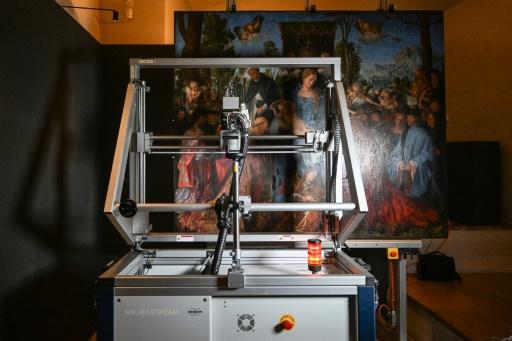
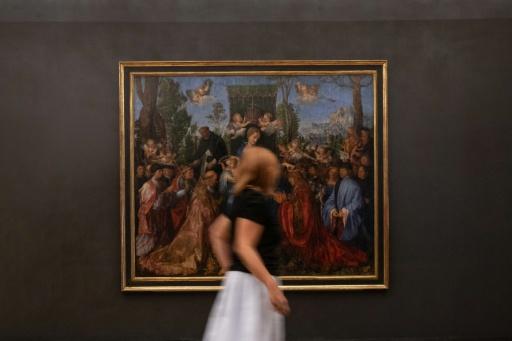
Albrecht Duerer's "Feast of the Rosary", a Renaissance gem of Prague's National Gallery, is facing a painstaking five-year reconstruction designed to set right five centuries of mistreatment and damage.
Experts have pointed out the poor condition of the colourful painting that the German master created for the San Bartolomeo church in Venice in 1506.
"Its state of preservation has been poor since the late sixteenth century," University of Texas art historian Jeffrey Chipps Smith wrote in a 2007 review.
True to the Venetian technique, Duerer used oil on poplar wood to depict the Virgin Mary holding a baby Jesus handing out rose garlands to believers including future Emperor Maximilian I and Pope Julius II.
But the material did not last and countless repairs and moves caused damage requiring an extensive revamp, National Gallery head Olga Kotkova told AFP.
"People say paintings are an organism similar to people, and when someone lives a reprehensible life, it is reflected in their faces," she said.
"It's similar with works of art."
Also known as "The Feast of the Rose Garlands", the painting will undergo scans to reveal "the tiniest details", said Adam Pokorny, chief restorer at the National Gallery.
To map the composition of the painting, the gallery will use macro-XRF scanning employed in the ongoing reconstruction of Rembrandt's "The Night Watch" by the Rijksmuseum in Amsterdam.
"We are also planning to make a 3D model of the painting, which will be useful to understand the condition of the wooden base," Pokorny told reporters.
A book published by the National Gallery on the 500th anniversary of the painting details its history.
Commissioned by the Confraternity of the Most Holy Rosary, a Catholic association sheltered by the Dominican order, the painting was praised widely and drew crowds of German worshippers to Venice.
It was carried on foot to Prague in 1606 when Holy Roman Emperor Rudolph II bought it for his collection.
It escaped looting by the Swedish army during the Thirty Years' War but fell into oblivion as Rudolph's collection was plundered.
Described as "completely destroyed" in an 18th-century inventory, the painting changed hands several times before ending up at the Strahov monastery near Prague Castle in 1793.
It underwent the first repair before the move to Prague, and other attempts followed, crowned by the efforts in 1839-1841 of Czech painter Johann Gruss, who was criticised for changing its surface and appearance.
"The paint has begun to fall off on the border between the original Duerer and Gruss's repair, millimetre by millimetre. The revamp is essential," said Kotkova.
Over the centuries, the painting has also lost a disputed element -- a fly that Duerer painted on Mary's knee.
In 1934, the state bought it for 9.6 million koruna, a record price for an art purchase by the government at the time, after the monastery rejected even higher foreign offers.
It spent World War II hidden in shelters.
Kotkova said only 75-80 percent of the work in its current state was still Duerer's "beautiful painting".
Pokorny said its "visual rehabilitation", in consultation with an international committee, would involve fixing the paint, removing poor-quality retouches and repairing the wooden base.
"With this scenario, we are looking at completion in 2031," Pokorny said.
Latest stories

Topthemen Trump und Venezuelas Übergangspräsidentin in New York erstmals zu Gespräch zusammengetroffen
US-Präsident Donald Trump und die venezolanische Übergangspräsidentin Delcy Rodríguez haben sich am Rande der UN-Vollversammlung in New York erstmals persönlich zu Gesprächen getroffen. Rodríguez sprach im Onlinedienst X am Dienstag (Ortszeit) von einem "historischen" Treffen und veröffentlichte ein Foto, auf...
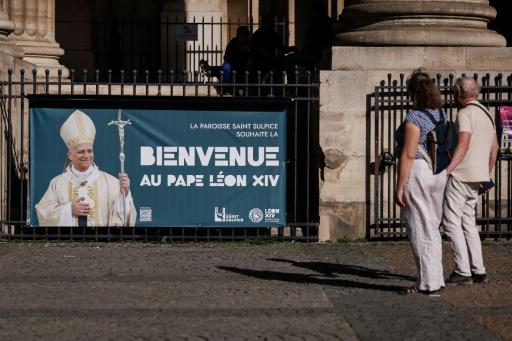
Topthemen Besuch von Papst Leo in Frankreich: Friedensbotschaft für Europa
Es ist der erste Staatsbesuch eines Papstes in Frankreich seit 18 Jahren: Papst Leo XIV. wird vom 25. bis 28. September in Paris, Lourdes und Metz erwartet. Der Umgang mit Missbrauch in der katholischen Kirche, das französische Sterbehilfe-Gesetz und eine politische Friedensbotschaft im Beisein europäischer Staats- und Regierungschefs prägen das Programm. Zur Messe auf der...
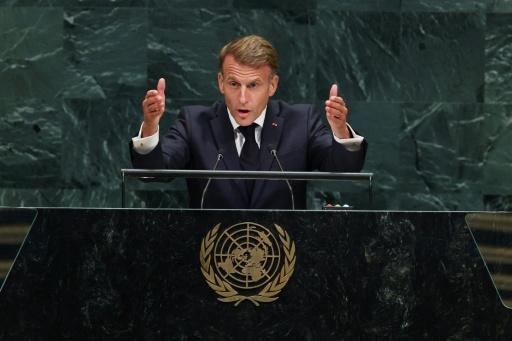
Weltgeschehen UN-Generaldebatte: Israel weist Macron-Äußerungen über Westjordanland als "grotesk" zurück
Israel hat empört auf die Rede von Frankreichs Staatschef Emmanuel Macron vor der UN-Vollversammlung reagiert, in der er die Lage im Westjordanland angeprangert hatte. Die "groteske Absurdität" von Macrons Äußerungen sei "schockierend", teilte das Büro von Israels Regierungschef Benjamin Netanjahu am Dienstag mit. Es bezog sich insbesondere auf Macrons Äußerung...