

Retailers are forecast to control 47% of the North American TV operating system (OS) market by 2029, up from 27% in 2025, according to Omdia's latest TV Design & Features Tracker. The rapid shift underscores how retailers are prioritizing e-commerce-driven retail media advertising over traditional TV shipment leadership.
This press release features multimedia. View the full release here: https://www.businesswire.com/news/home/20260126712811/en/
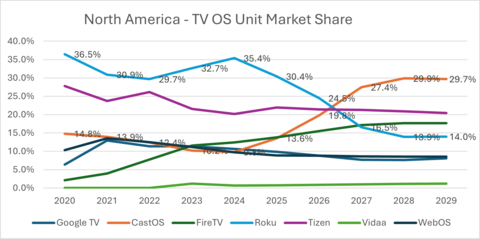
North America - TV OS Unit Market Share
This trend was a key theme at CES 2026 in Las Vegas, alongside conversational AI driven features.
Globally, Omdia forecasts that the TV OS opportunity is consolidating into three distinct segments. In China, localized Android forks without Google services continue to dominate holding a stable 96% share a level Omdia expects to persist through the forecast period. In the rest of the world (excluding North America and China), Google TV currently leads with a 40% share but will lose share gradually to three key competitors: VIDAA, Titan and TiVo.
Omdia projects an inflection point in 2027 for North America when Walmart’s CastOS shipments reach 14.0 million units. This is driven by Walmart’s acquisition of Vizio and the expansion of its CastOS platform. After the acquisition of Vizio, Walmart has rapidly increased Vizio unit shipments from 4.8 million units in 2024 to a projected 6.6 million units in 2025, representing a 37.5% increase. Simultaneously, Amazon increased FireTV unit shipments from 6.1 million units in 2024 to a projected 6.8 million units in 2025, an 11.5% increase.
By 2029, Omdia projects Walmart’s CastOS will reach 14.8 million units and Amazon FireTV will reach 8.8 million units. Consequently, these two retailers will ship a combined 23.6 million units into a total market of 50.0 million units.
“At CES 2026, VIDAA OS underwent a major transformation,” said Patrick Horner, Practice Leader, TV Set Research, Omdia. “The operating system is transitioning to a new name, V Home OS, to reflect its broader role beyond just televisions. A significant partnership with Microsoft was announced to integrate Copilot’s generative AI capabilities directly into the platform, enhancing the user experience with advanced AI services. The name change is part of the wider push by the company to be an operating system that encompasses not only AI but also, eventually, acts as a shopping portal.”
Google integrated its Gemini AI into Google TV and, at CES, Google introduced interactive shoppable video. AI-driven "shoppable" prompts are tied to on-screen content and are designed to bridge the gap between watching and buying by using AI to identify items on screen. At CES 2026, Google emphasized "direct paths" from discovery to checkout without leaving the interface. “Users can engage in conversational shopping. For example, a viewer could ask, "Where can I buy those sneakers?" while watching, and the TV can identify the brand and provides a QR code or an option to add the item to a Google Shopping cart. This confirms that across multiple TV OS platforms, enabling shopping is a key market driver,” concluded Horner.
ABOUT OMDIA
Omdia, part of Informa TechTarget, Inc. (Nasdaq: TTGT), is a leading technology research and advisory group. With deep expertise in technology markets, grounded in insightful conversations with industry leaders and supported by hundreds of thousands of data points, Omdia's strategic market intelligence is our clients' competitive advantage. From R&D to ROI, we identify the most promising opportunities to drive the industry forward.
View source version on businesswire.com: https://www.businesswire.com/news/home/20260126712811/en/
© Business Wire, Inc.
Disclaimer :
This press release is not a document produced by AFP. AFP shall not bear responsibility for its content. In case you have any questions about this press release, please refer to the contact person/entity mentioned in the text of the press release.