


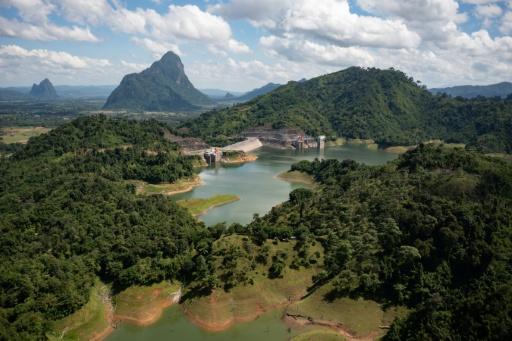
Isolated, under-developed Laos brands itself the "Battery of Southeast Asia", powering its neighbours with dozens of hydroelectric plants, but frequent power outages leave its own people in the dark.
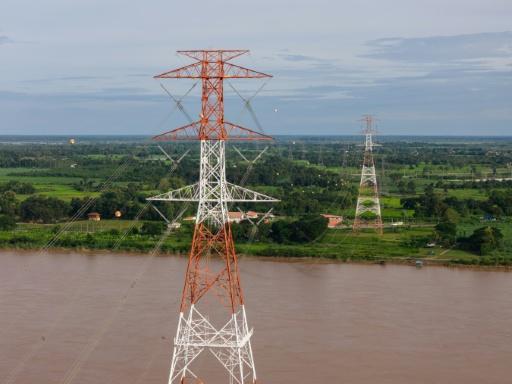
Exports of electricity to neighbouring countries including Thailand and Vietnam are a key source of revenue for the landlocked nation, designated as a least developed country by the United Nations.
But most of the power generated leaves the country and, combined with an ageing grid, that results in frequent outages and sometimes having to import electricity to meet demand.
When the power cuts out after dark in Vientiane, families wander outside to avoid the stifling heat indoors, using cell phones to light their way.
At one of the two main public hospitals, a doctor in the pediatrics emergency department is used to watching medical equipment suddenly shut down until the generators kick in.
"Over the past three to six months, we've often faced electricity problems, especially at the children's centre," said the doctor, who spoke on condition of anonymity.
"A ventilator came to a halt, but we do have a generator at the hospital."
When old wiring recently caused an electrical fire in the alley outside the hospital, a blackout cut power to X-ray, ultrasound and ventilator equipment, she said.
Elsewhere in the city, a front-desk staffer at a health clinic said power outages occurred two to three times a week, usually announced beforehand.
Without a generator, "we have to reconnect the electricity from a store next to us", said the staffer, who also requested anonymity in a one-party communist state where authorities do not tolerate dissent.
When the power is restored, the cry rings out across the city: "It's back!"
Laos exported around two-thirds of its total generated electricity in 2023, according to the World Bank, but experts say that figure is now even higher.
One former technical expert at state utility Electricite du Laos (EDL) put the figure at around 80 percent.
In the decade to 2024, annual electricity exports more than tripled, from 12 terawatt-hours (TWh) to 38 TWh, according to official data -- enough to power Paris for a year and a half.
In 2023, they brought in $2.65 billion, according to the government, often sold in deals struck by the state with businesses that invest in Laos's infrastructure.
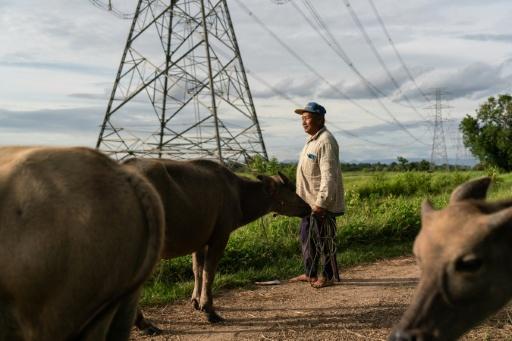
"Transmission lines from most projects are 'dedicated' to their customers," said Grant Hauber, an Asia adviser at the Institute for Energy Economics and Financial Analysis.
"Meaning they are not connected domestically to Laos consumers."
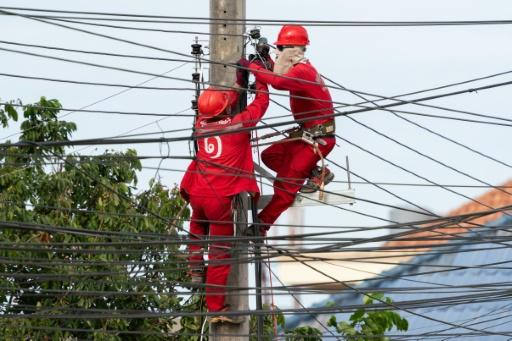
Much of Laos's distribution grid dates back to the 1970s, and now struggles to keep pace with an increasingly modern economy of tourism, massive infrastructure, urban development and air conditioning.
In Vientiane, a power line once used for one household now covers whole apartment blocks with many units, straining old transformers.
In rural areas, if a tree falls onto the power lines, it can cause a blackout for one village, sometimes several, because there is no backup.
Bounchan Manochit, a shop owner in northern Luang Prabang province, said that with no lights, wild animals may enter residents' homes at night.
"We can't see them," she said. "It can be dangerous."
Almost all of Laos's population of eight million has access to electricity, up from just 15 percent in 1995, according to the government.
But EDL, charged with maintaining the grid, is tackling large debts incurred during the expansion and due to consumer subsidies.
With hydropower accounting for 80 percent of production as of 2024, supply dwindles in the dry season from March to August.
At times, Laos has struggled to provide power to its neighbours and finds itself importing energy, at significant cost, according to a recent World Bank report.
"Electricity production has already fallen short of domestic demand and export contracts on several occasions," it said.
Laos's main export market is Thailand but it is diversifying its client and energy mix.
Vietnam has recently stepped up imports, including through Laos's Monsoon Wind project, the region's largest wind farm that became operational last year.
Researcher Le Hong Hiep of the ISEAS-Yusof Ishak Institute noted the growing demands of Vietnam's manufacturing sector and the country's own issues with energy production -- but said politics also played a part.
"Vietnam also wants to import more electricity from Laos to increase its leverage over Laos," part of a wider contest with China for influence in Vientiane, he said.
The energy from the Monsoon Wind project is destined only for Vietnam.
"Zero for local," noted the former expert at EDL.
Latest stories
Monde La gauche ou des ministres d'extrême droite? Scrutin à suspense en Suède
La Suède va-t-elle assister au retour de la gauche au pouvoir? Ou à l'entrée fracassante de l'extrême droite au gouvernement? Verdict dimanche au terme d'une campagne haletante, qui s'est...

La Une US Open: Rybakina nouvelle reine de New York et du circuit
Deux finales en 2026, et deux titres: Elena Rybakina a été sacrée samedi pour la première fois à l'US Open en détrônant la double lauréate Aryna Sabalenka, après lui avoir déjà ravi...

Sport Tennis: Elena Rybakina, une force tranquille et impénétrable
Elle est aussi explosive raquette en main qu'impénétrable pour ses adversaires et les journalistes: lauréate samedi à l'US Open de son troisième titre en Grand Chelem, la nouvelle N.1 mondiale Elena Rybakina est une...